
Stop Paying the Dark Tax
Locate the arc. Restore the grid. Arc Detection and Localization puts the fault on your single-line diagram before crews leave the depot, so healthy bays come back online fast, and downtime stops accumulating.
See what your substation's real exposure looks like, and how quickly that risk turns into a return. One prevented outage. Full system payback. Use the calculator below to see what your substation's real exposure looks like and how quickly that risk turns into a return.
*Indicative figures only. Results vary by site configuration.
The Problem
Where the Dark Tax Accumulates
When GIS fails, its design protects but it also hides the fault. Arc faults are high-energy, high-impact events. In enclosed GIS, locating the origin often means manual inspection across compartments: slow, expensive, and risk-exposing. Your team knows the response protocol. What's harder to see is how each step adds cost and time, every incident.
Time Lost
The fault is inside a sealed enclosure. SCADA shows an outage. Protection shows a fault. Neither tells you which bay — and the clock is already running.
Manual Inspection
Crews mobilize without a destination. Drive time, access procedures, and permits start before the location is confirmed. If the first bay isn't right, the sequence repeats.
Safety Risk
Without confirmed localization, operators are exposed to high-voltage environments during fault response — and healthy bays stay dark longer than they need to.
Restoration Cost
For transmission utilities serving critical infrastructure, the value of lost load accumulates fast. Few teams run the number against their real response time.
How Arc Detection Closes the Gap
PD monitoring helps prevent failure. Arc events demand immediate location. Arc Detection is not condition monitoring; it is grid restoration acceleration for the rare GIS events where the priority is to identify the faulted bay and re-energize healthy bays. Most tools tell you something happened, but not exactly where or fast enough to reduce the outage scope. Not a slow-burn trend. An emergency response tool that activates the moment a flashover occurs.
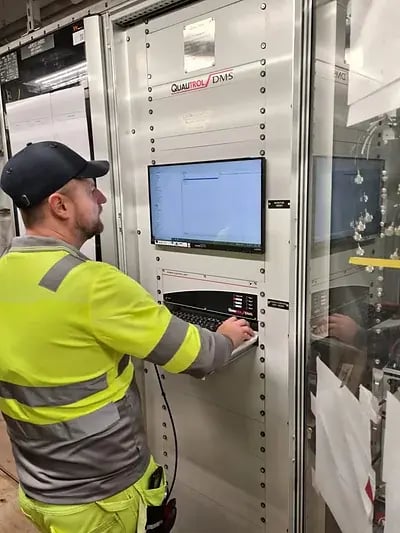
Fault location before crews leave the depot
From the arc event to localization on the schematic. The system highlights the arc fault location on your single-line diagram. The faulted bay and compartment appear on your SLD in under a minute. Operators know which bay immediately, before anyone moves.
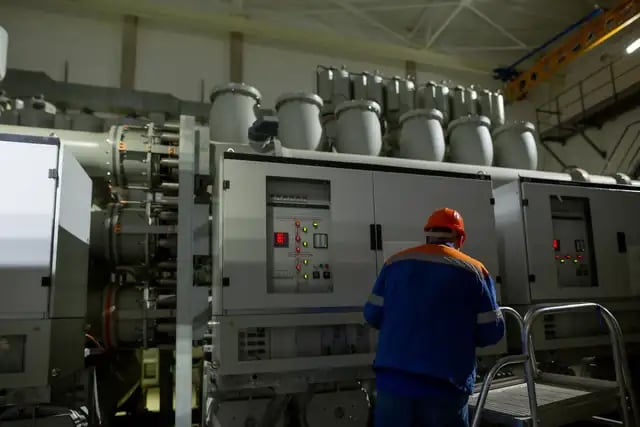
Re-energize healthy bays without delay
With the fault confirmed and isolated, operators can restore the rest of the substation instead of holding everything offline.
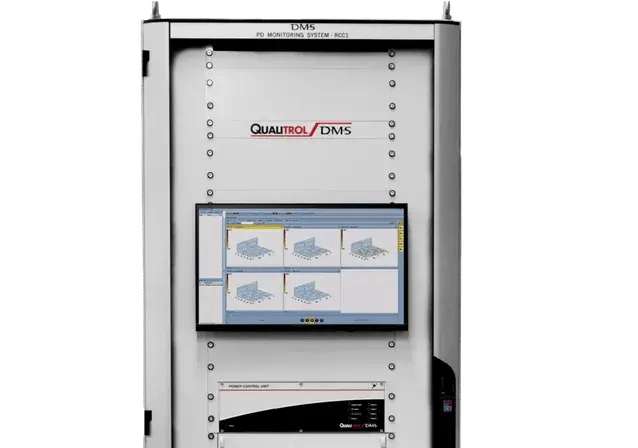
Software retrofit. No infrastructure overhaul
- Existing UHF sensors — no new hardware in most deployments, no invasive install, faster time-to-protection.
- No gas handling — sealed compartments stay closed.
- AI and ANN-based classification — discriminates switching arcs from fault arcs, with multi-sensor correlation to confirm the same event.
- Multi-manufacturer — works across diverse GIS fleets.
Measure It
Calculate your Dark Tax
Compare expected costs with and without Arc Detection and Localization. Enter your site parameters and see the results update automatically.
Your site inputs
Adjust values to match your substation and response profile.
Voltage class:
ROI summary
Directional estimate based on your inputs
Without Arc Detection
Total cost without system
$500,000
With Arc Detection
Total value with system
$750,000
Avoided failure savings
$500,000
Outage time savings
$250,000
Net savings
$350,000
Return on investment
87.5%
All figures are indicative only. Actual system costs vary depending on the size of the GIS, number of UHF sensors, site configuration, and other factors. Contact a Qualitrol specialist for a site-specific assessment.
Note on hardware utilization: The UHF sensor infrastructure that enables Arc Detection and Localization also supports continuous partial discharge monitoring, giving you both emergency response and long-term condition monitoring with no additional hardware investment.
Field Evidence
Validated at 400 kV in the field
In early 2025, Qualitrol deployed and tested the Gen3 UHF PDM + Arc Detection system at a live 400 kV GIS substation, not a lab. Every injected arc-like signal was accurately detected and located. Arc Detection and Localization is built to use your existing PDM system to locate faults faster, with no new monitoring infrastructure required.
100%
Detection accuracy at the 400 kV live site
80%
Reduction in fault localization time vs. manual inspection
<50 min
Time to full payback avoiding a single outage event
Fault location displayed on the Single Line Diagram in real time. Operators knew exactly which bay without opening a single compartment, reducing localization to approximately 20% of the time required for manual inspection.
Reduced outage time by up to 80% by eliminating manual inspection across multiple bays. Technicians re-energize unaffected sections without physical deployment to the site, saving thousands of maintenance dollars per shift.
Improved operator safety by minimizing exposure to high-voltage environments during fault response. Timely, targeted intervention reduces the risk of equipment failure and secondary incidents.
One platform for everything. Arc Detection, Partial Discharge monitoring, and Gas Density combined into a single GIS monitoring system, streamlining maintenance planning and simplifying operations.
Case Study
Arc Detection and Localization Testing at a 400 kV GIS Substation
Author
Bharat Nandula, CBM Product Manager
Published
January 2026
Site
400 kV live GIS substation
Common Questions
What utilities ask before evaluating
The system continuously monitors UHF signals associated with arc or partial discharge activity. Upon detecting an arc-type signature, it records the event, analyzes the signal to distinguish it from others, and indicates the location of the arc on the single-line diagram.
Approximately 80% time and cost savings by reducing site investigation time and enabling faster power restoration. For critical substations, prompt identification of the faulted bay allows healthy bays to be re-energized without waiting for full manual inspection.
No. It adds high-value capability on top of the existing PD monitoring system. Arc Detection and Localization is an enhanced feature within the Gen 3 (PDMG-RH) solution, combining arc detection with PD monitoring for more complete GIS coverage. PD monitoring is condition-based and long-term. Arc Detection is an emergency response tool that activates at the moment of a flashover and identifies the fault location immediately.
GIS failures are rare, sudden, and high-impact. You invest because when it happens, the operational and economic consequences are severe. This capability is particularly valuable for critical substations, enabling prompt power restoration by isolating the faulted bay and re-energizing healthy sections without delay.
The Arc Detection feature leverages your existing UHF sensors. Signals are sent to an upgraded OCU that records arc-related events and applies built-in AI and ANN analytics to identify arc activity and estimate location. The feature integrates into the existing PDM workflow, providing a clear upgrade path without starting from scratch. No new sensors are required in most deployments.
Yes. A case study documents deployment and testing at a live 400 kV GIS substation, including simulated arc-like signal injection. Every injected signal was accurately detected and located. Refer to the case study for full details.
Designed for transmission-class GIS at 66 kV–400 kV.
One Platform
One Platform. Complete GIS condition visibility.
The same platform that monitors Partial Discharge, Gas Density, and Breaker health — now with Arc Detection and Localization built in.
Arc Detection & Localization
Grid restoration acceleration
Partial Discharge Monitoring
Condition monitoring
Gas Density Monitoring
SF6 integrity
Breaker Monitoring
Switching performance
Get in Touch
Request a consultation
Talk with a Qualitrol specialist about Arc Detection and Localization for your GIS substations.